
Volunteer Coordination
An association that works is often 80% of the load carried by 20% of the volunteers. The same faces in the same positions, year after year, until burnout. Meanwhile, dozens of people registered as volunteers wait to be called upon: but no one has the time to match their availability with actual needs.
The volunteer coordinator juggles between text messages, phone calls, WhatsApp messages that get lost. He knows by heart the three reliable people he can call in an emergency, but is unaware that Marie, who registered six months ago, has first aid training. Events approach, schedules are built in haste, no-shows multiply.
And when a faithful volunteer moves away or burns out, the entire organisation wavers. The problem is not a lack of goodwill: it is the absence of a system to mobilise them intelligently.
This solution belongs to the Business Operations & ERP family.

Challenges holding back your performance
The Excel file of volunteers exists in every association. It contains names, sometimes telephone numbers, rarely up to date. Impossible to filter by skill, by geographical area, by available time slot. Doodle helps for a one-off event, not for managing 150 volunteers over a season.WhatsApp groups overwhelm those who are already involved and make those who cannot respond to everything feel guilty. HR tools on the market are designed for employees with contracts and obligations: not for people who give their time freely and can disappear without notice.Result: we always call upon the same people, we lose new ones through lack of follow-up, and no one has a clear view of the volunteer capacity that can actually be mobilised.
Our Technical Approach
Our approach stems from a simple observation: a volunteer is not a part-time employee. One must offer them assignments that correspond to their interests, available time and skills: not impose a schedule upon them. Each volunteer has a personal space where they input their availability, expertise and preferences. On the organisation side, an allocation algorithm suggests relevant profiles for each assignment: need a driver Saturday morning?
The system identifies who holds a driving licence, who is available, who has not been called upon for some time. The integrated messaging system enables targeted proposals to be sent without overwhelming everyone. We automatically balance the workload to avoid over-soliciting the most committed volunteers. The coordinator retains control over final assignments, but with complete visibility: who does what, who has never been called upon, who accumulates cancellations.
Secure personal spaces
Algorithms for assignment of missions
Internal integrated messaging
Technical Architecture
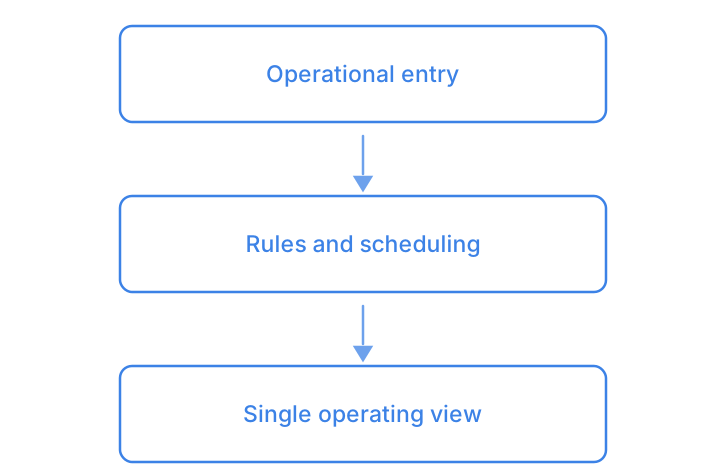
Enter once, let the rules schedule, read a single view: this foundation is shared across the family — you will find it in Management Systems (PMS) and in Order Management System (OMS).
- Secure personal spaces
- Algorithms for assignment of missions
- Internal integrated messaging
Smooth and frictionless integration
No need to discard your Excel file or recreate all the profiles. We import your existing data, clean up duplicates, and identify missing information. Volunteers complete their own profiles via a personalised link: it’s also an opportunity to reactivate those we had lost touch with. The tool is used from a web browser, with no application to install.
If you already use a charity CRM or membership management tool, we establish the necessary connections.
Audit of your volunteer base
We analyse your existing files, your current communication channels, and identify the missing information required for effective management.
Configuration and import
Configuration of mission types, required skills, and operational areas. Import and cleansing of your existing data.
Activation of volunteers
Personalised communication to volunteers to complete their profile. Support for coordinators on the allocation tool.
Running-in on an actual event
Initial deployment on a concrete mission, adjustments based on field feedback, then complete autonomy for your team.
Measurable results for your organisation
- 60% reduction in time spent assembling teams for each event
- Response rate to appeals doubled through targeted outreach
- Reduction in no-shows by 35% with the confirmation and reminder system
- Reactivation of 25 to 40% of registered volunteers who have never been approached
- Balanced workload distribution: gap halved between most and least utilised volunteers
- Real-time visibility of skills available within the volunteer database
Clarifying your decision-making
Our volunteers are not very comfortable with information technology; is it genuinely user-friendly?
The volunteer interface is deliberately minimal: entering availability takes two minutes, responding to a mission proposal takes one click. Clarendis has tested it with associations whose average age exceeds 65. For those who prefer the telephone, the coordinator enters the information on their behalf.
We’ve already tried tools, the volunteers don’t use them. What’s different?
Most tools ask volunteers to check rotas and put themselves forward. Here the logic is reversed: targeted proposals matching their profile are sent to them. They receive fewer messages, but relevant ones, and engagement rises because their time is respected.