
Quotation & CPQ Systems
In B2B services, each commercial proposal is a balancing exercise. Your offers combine human time, deliverables, outcome commitments, sometimes equipment or third-party licences. A senior consultant at €850/day, a junior at €420, travel expenses varying according to the client, discounts negotiated case by case, payment terms that depend on credit risk.
Your sales teams spend hours assembling these puzzles in Excel or Word, searching for the right rates in scattered files, requesting their manager to validate a 12% discount. Meanwhile, the prospect waits. And when the quotation finally goes out, nobody really knows if the margin will be as planned: because the salesperson forgot to include subcontracting costs, or applied an obsolete rate.
Errors are discovered at invoicing, when it’s too late. Good salespeople know the rules by heart. The others improvise.
This solution belongs to the Billing, Quoting & Configurators family.

Challenges holding back your performance
Excel remains the tool of choice, but it doesn’t understand your business rules. A salesperson can propose a 25% discount on a service with already slim margins, and no one will see it before signing. Word templates circulate in ten different versions, some with expired terms and conditions. Approvals go through email: lost in inboxes, chased up manually.When a prospect requests a modification, you start from scratch or cobble something together in a rush. CPQ tools exist in the market, but they’re designed for selling manufactured products with fixed bill of materials, not for the complexity of services where each line item can be negotiated.The result: your teams spend more time formatting documents than understanding client needs.
Our Technical Approach
Our approach starts with your actual catalogue, not a theoretical model. We begin by mapping your services, their dependencies (such service requires such other), their incompatibilities (one does not sell strategic consultancy with staff augmentation to the same client), and most importantly your margin rules: those that are written down, and those that live in your sales director’s head.
The configuration engine then guides the salesperson: they select a type of engagement, the system proposes the relevant components, calculates the margin in real time, blocks or alerts if a threshold is breached. Discounts follow clear rules: up to 10% autonomously, beyond that manager validation with instant notification. The quotation generated is not a cobbled-together PDF: it is a document in your image, with professional layout, which goes for electronic signature without leaving the system.
Everything is tracked: who proposed what, who validated, when.
Guided Configuration (Bundles)
Constrained bundling (e.g.: if Software A is sold, then 2-day training is mandatory).
Margin and Discount Engine
Dynamic calculation of deal profitability to avoid selling at a loss.
Approval Workflows
Automatic triggering of hierarchical approval if the discount exceeds 15%.
Premium PDF Generation
Instant creation of a design-focused commercial proposal, including up-to-date terms and conditions.
Integrated Electronic Signature
Direct sending of the generated document to platforms such as DocuSign or Yousign.
Catalogue Centralisation
A single repository ensuring that sales teams use the correct pricing.
Technical Architecture
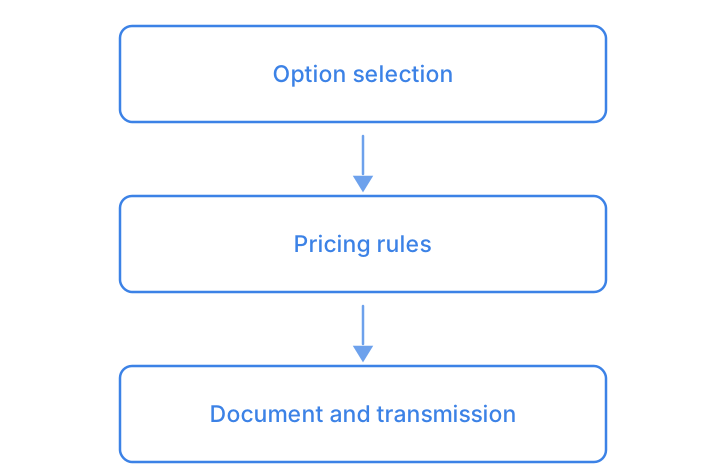
Select options, apply pricing rules, produce the document: Complex Commission Management and Monetisation & Subscriptions rest on this sequence.
- Guided Configuration (Bundles)Constrained bundling (e.g.: if Software A is sold, then 2-day training is mandatory).
- Margin and Discount EngineDynamic calculation of deal profitability to avoid selling at a loss.
- Approval WorkflowsAutomatic triggering of hierarchical approval if the discount exceeds 15%.
- Premium PDF GenerationInstant creation of a design-focused commercial proposal, including up-to-date terms and conditions.
- Integrated Electronic SignatureDirect sending of the generated document to platforms such as DocuSign or Yousign.
- Catalogue CentralisationA single repository ensuring that sales teams use the correct pricing.
Smooth and frictionless integration
Your CRM remains the entry point: we connect the CPQ engine to your CRM, your marketing tool, your ERP or Pipedrive according to your existing setup. Pricing data can remain in your ERP, synchronised daily. No need to migrate your historical records: old quotations remain where they are, new ones go through the system. Your sales teams maintain their working habits, with an additional button in their usual interface.
Deployment begins with a pilot team, often the most sceptical sales personnel: they are the ones who validate that the tool is robust before rolling it out.
Catalogue and rules audit
Analysis of your current services, pricing structures, margin rules and approval processes. We identify what needs to be modelled and what can remain flexible.
Configuration of the CPQ engine
Configuration of service bundles, pricing rules, discount thresholds and validation workflows. Creation of your document templates.
Integration and driver
Connection to your CRM and potentially your ERP. Deployment with a test team, adjustments based on field feedback.
Deployment and training
Extension to the entire sales team, practical training on real cases, implementation of performance indicator monitoring.
Measurable results for your organisation
- Complex proposal creation time reduced from 2-3 hours to 25 minutes on average
- Elimination of pricing errors — actual margin aligned with forecasted margin at 98%
- Discount approval cycle reduced from 48h to 2h through automated workflows
- Quote conversion rates increased by 15 to 20% due to enhanced responsiveness
- 100% of proposals compliant with current Terms and Conditions and brand guidelines
- Real-time visibility into the commercial pipeline and forecast margins
Clarifying your decision-making
Our offerings are highly bespoke; will a CPQ system not confine us within rigid frameworks?
A CPQ system handles standard cases to free up time for complex ones, without confining your offering. Your sales team can still create free lines for atypical services; those simply trigger a validation step. The objective is not to automate everything, but to automate what can be automated.
How long before our sales team actually use it on a daily basis?
The first quotations reach production 6 to 8 weeks after launch in our deployments. Actual adoption depends less on the tool than on the commitment of your sales management. Clarendis trains a pilot team, adjusts to its feedback, then deploys.