
Time & Fixed-Fee Billing Engines
In a consultancy, law firm or digital services company, each hour worked has a different contractual value. A senior consultant at €850 per day on a time and materials contract, a junior at €420 on a capped fixed-price arrangement, travel expenses rechargeable at 100% for one client and 70% for another. Multiply this by 50 staff members, 30 active clients and contracts that change every quarter.
The result: administrative teams spending the first week of each month reconciling incomplete timesheets, tracking down unrecorded expenses, checking fixed-price caps, applying the correct VAT rates according to jurisdictions. Meanwhile, cash flow waits. Consultants chase up their expense claims. Clients receive late invoices, sometimes with errors that trigger disputes lasting several weeks.
And the Finance Director spends his evenings reconstructing reliable MRR for the executive committee. This is not a competence issue. It is a problem of volume and contractual complexity that exceeds what manual processes can handle.
This solution belongs to the Billing, Quoting & Configurators family.

Challenges holding back your performance
Excel holds up with 10 clients and straightforward contracts.Beyond that, it becomes a trap: formulae broken during copy-paste operations, versions that diverge between sales and billing, no audit trail when a client disputes a line item. General ERP systems offer billing modules designed for trading or manufacturing: they cannot handle a fixed-fee arrangement with authorised overage at reduced rates, nor a mixed contract comprising time and materials + subscription + success fees.So one cobbles together solutions: manual exports, mapping tables, human verification at each cycle. The hidden cost is enormous: billing delays of 15 to 20 days on average, error rates of 3 to 5% on line items, and administrative hours that could be utilised elsewhere.
Our Technical Approach
Our approach starts with the contract, not the invoice. Each client engagement is modelled with its own pricing logic: rates by profile, caps, indexation, expense recharging conditions, revision terms. This contractual repository becomes the single source of truth. Time entries—whether they come from your current timesheet tool, an Excel import or direct input—are automatically valued according to the rules of the relevant contract.
Expenses follow the same path. A consolidation engine aggregates these elements, applies the groupings requested by each client (one invoice per project, per month, per legal entity), and generates pre-validated entries. Approval workflows adapt to your organisation: managerial validation of time, engagement director sign-off above a threshold, specific process for credit notes.
Document generation produces invoices in the format expected by each client, detailed appendices included. Accounting export feeds your system without re-keying.
Timesheet Consolidation (CRA)
Automated aggregation of hours entered by consultants on the project.
Mixed Contract Engine
Simultaneous management of package milestones, time spent (Time and Materials) and expenses.
Subscription Management (MRR)
Automatic recurring invoicing for support contracts (Application Maintenance, Hosting).
Complex Billing EnginesnnApproval Workflows
Validation process by the engagement director prior to final issuance to the client.
Documentary Generation
PDF creation of the invoice accompanied by its appendices (breakdown of days worked).
Automated Accounting Export
Revenue breakdown by analytical dimensions (by department, by offering) to the ERP.
Technical Architecture
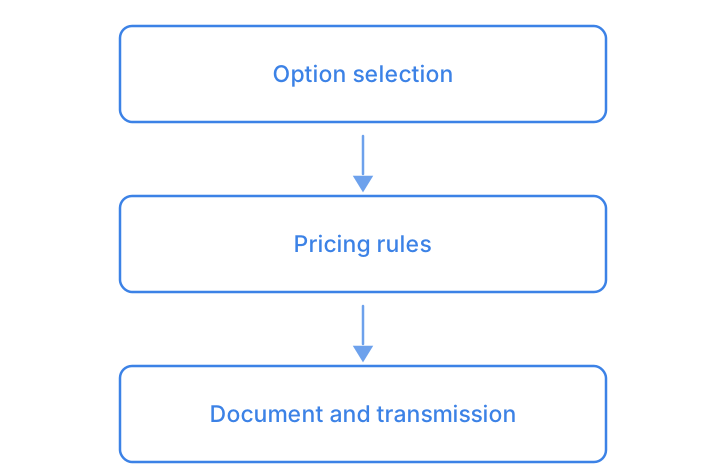
Select options, apply pricing rules, produce the document: Complex Commission Management and Monetisation & Subscriptions rest on this sequence.
- Timesheet Consolidation (CRA)Automated aggregation of hours entered by consultants on the project.
- Mixed Contract EngineSimultaneous management of package milestones, time spent (Time and Materials) and expenses.
- Subscription Management (MRR)Automatic recurring invoicing for support contracts (Application Maintenance, Hosting).
- Complex Billing EnginesnnApproval WorkflowsValidation process by the engagement director prior to final issuance to the client.
- Documentary GenerationPDF creation of the invoice accompanied by its appendices (breakdown of days worked).
- Automated Accounting ExportRevenue breakdown by analytical dimensions (by department, by offering) to the ERP.
Smooth and frictionless integration
The system connects to existing infrastructure. Your time recording tool remains in place: we retrieve data via API or files. Your accounting ERP continues to handle the accounts: we send it clean entries. The same logic applies to expense reports or CRM.
The objective is not to replace your application estate but to create an intelligence layer between operational reality (time spent, expenses incurred, contracts signed) and accounting production. Phased deployment: a pilot scope of 2-3 representative clients, then progressive extension.
Complex Billing EnginesnnContractual mapping
Analysis of your contract typologies, pricing rules, exceptions. Identification of edge cases and existing data sources.
Complex Billing EnginesnnModelling and connectors
Construction of the contractual repository, configuration of valuation rules, connection to your time and expense recording tools.
Driver on restricted perimeter
Go-live on 2-3 test clients. Validation of calculations, adjustment of approval workflows, system familiarisation with teams.
Deployment and Autonomy
Extension to the entire portfolio, training of key users, documentation of procedures. You are autonomous on routine developments.
Measurable results for your organisation
- Reduced average billing turnaround time from 18 days to 4 days following period closure
- Error rate on billing lines reduced from 4% to less than 0.5%
- Savings of 3 to 5 person-days per month on consolidation and verification tasks
- Real-time visibility on MRR and revenue to be invoiced
- 60% reduction in client disputes related to billing discrepancies
- Complete traceability: each invoice line can be traced back to its source (time, expenses, contract)
Clarifying your decision-making
Our contracts are genuinely atypical, with clauses negotiated client by client. Can your system adapt accordingly?
A billing engine models each contract individually, which is precisely what clauses negotiated client by client require. Differentiated rates by profile, caps with or without carry-over, degressive tiers, conditional success fees: Clarendis has already handled these cases. A clause we have never encountered is modelled with you before work begins.
How long before having an operational system?
A pilot billing scope is functional within 6 to 8 weeks in our deployments, covering two to three representative clients. Scaling across the full portfolio then takes two to three months, depending on the number of contracts to model and the complexity of your validation processes.