
Clinical Trial Management (eCRF)
A clinical trial represents years of work, millions of euros invested, and sometimes the hope of patients who have no other options. Everything depends on the quality of the data collected. Your CRAs spend their days entering observations, checking vital signs, tracking inconsistencies. Your data managers juggle between investigator sites that aren’t using the same versions of forms.
Your biostatisticians await clean exports that never arrive in the correct format. And above all of this, regulatory requirements continue to tighten: FDA 21 CFR Part 11, EMA Annex 11, GDPR for health data. Each unresolved query delays database lock. Each missing data point can invalidate an evaluation criterion.
Institutional sponsors such as university hospitals or INSERM, the French public research institute, don’t have the budgets of Big Pharma to afford the market giants.
But they have the same traceability obligations, the same quality imperatives, the same pressure from ethics committees.
This solution belongs to the Data, Master Records & Reporting family.

Challenges holding back your performance
Excel remains surprisingly widespread in French clinical research. Workbooks are created per site, consolidation is done manually, and one prays that nobody overwrites a formula. No audit trail. No rights management by profile.Anonymisation relies on good will. eCRF tools exist on the market, but per-patient licensing costs blow academic study budgets. Configuration takes months. The slightest protocol amendment requires a contract addendum with the vendor.Some make do with generic web forms such as REDCap, which are functional but limited when managing complex query workflows or CDISC-compliant exports is required.Result: studies that spiral in costs and timelines, data that must be reworked before submission to authorities.
Our Technical Approach
We build eCRFs that align precisely with your protocol, not the other way round. Each form reflects your paper CRF validated by the Ethics Committee, with coherence controls integrated from the point of data entry: impossible dates, values outside physiological bounds, inconsistencies between visits. The audit trail is immutable: every modification, by whom, when, why, without possibility of deletion.
The query workflow follows your organisation: the CRA issues, the investigator responds, the data manager closes. Anonymisation is structural: identifying data remains at the site, only the randomisation number circulates. Monitoring is conducted in real time: completion rates by site, open queries, patients overdue for visits. Exports are generated directly in CDISC format (CDASH, SDTM) for your biostatisticians.
No re-entry, no manual mapping. The system is hosted on qualified HDS infrastructure, with documented PQ/IQ/OQ for your inspections.
Consistency Checks
Strict rules (Data Validation) blocking the entry of clinically absurd values.
Immutable Audit Trail
Logging of who modified what, at what time, with mandatory reason.
Management of Queries
Integrated communication workflows between data managers and investigators.
Strict Anonymisation
Algorithmic separation between patient identity and clinical data (Pseudonymisation).
Cohort Monitoring
Visual dashboards on recruitment progress by investigation centre.
Statistical Export (CDISC)
Generation of formatted datasets for biomedical analysis software (SAS, R).
Technical Architecture
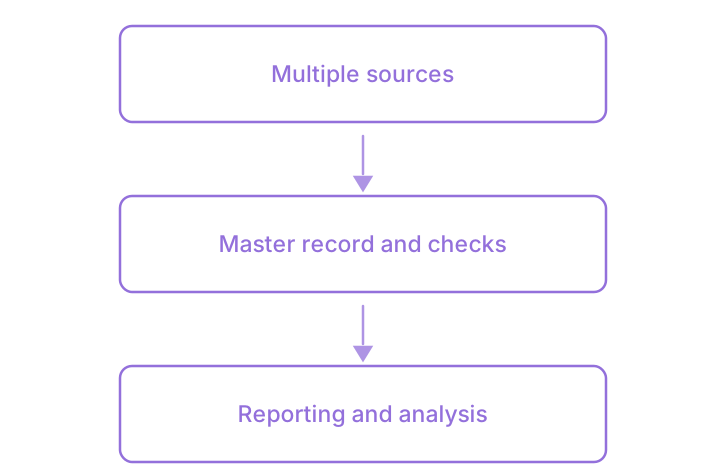
Several sources, one master record to arbitrate between them, then analysis: Batch Traceability & Genealogy and Core HR & Unified Repository stem from this same chain.
- Consistency ChecksStrict rules (Data Validation) blocking the entry of clinically absurd values.
- Immutable Audit TrailLogging of who modified what, at what time, with mandatory reason.
- Management of QueriesIntegrated communication workflows between data managers and investigators.
- Strict AnonymisationAlgorithmic separation between patient identity and clinical data (Pseudonymisation).
- Cohort MonitoringVisual dashboards on recruitment progress by investigation centre.
- Statistical Export (CDISC)Generation of formatted datasets for biomedical analysis software (SAS, R).
Smooth and frictionless integration
Has your study already commenced on paper or on another system? We shall migrate the existing data using a jointly validated mapping process. Are your investigators already utilising a hospital portal? We shall interface via SSO to avoid the proliferation of credentials.
Do your CRCs have established practices? The interface replicates the logic of your paper CRFs to minimise training requirements. We deploy centre by centre if necessary, with a pilot on your most mature sites before rollout.
Analysis of the protocol
Review of your paper CRF, identification of consistency checks, mapping of query workflows and roles by centre.
Construction and validation
Development of the eCRF, drafting of functional specifications, user testing with your CRAs on a pilot site.
Deployment and training
Production deployment on HDS infrastructure, training of investigators and CRCs, validation documentation for your regulatory submission.
Monitoring and closure
Continuous monitoring of data quality, query support, preparation of CDISC exports for database lock.
Measurable results for your organisation
- 60% reduction in query resolution time through real-time controls
- Database lock timeline shortened by 3-4 weeks on average
- Zero findings related to data integrity during ANSM inspections on deployed studies
- Cost per patient 40 to 70% lower than leading commercial eCRF solutions
- CDISC exports generated in under 24 hours versus 2-3 weeks of manual reworking
- Missing data rate reduced to below 2% through proactive monitoring
Clarifying your decision-making
Are you qualified for trials subject to FDA approval?
The eCRFs built by Clarendis comply with 21 CFR Part 11: electronic signature, complete audit trail, role-based access control. We supply the IQ, OQ and PQ validation documentation required for inspections, and have supported studies with FDA submissions without technical findings.
What happens if the protocol is amended during the course of the study?
Protocol amendments are part of routine operation: the form is versioned, existing data migrated with full traceability, and new fields apply to future visits. History remains intact for data already entered. Allow 1 to 2 weeks depending on the complexity of the amendment.