
Clinical Systems Interoperability
A patient arrives at A&E. The junior doctor searches for their allergy history, but the department’s software does not communicate with that of the hospital pharmacy.
Result: 15 minutes wasted telephoning archives, a risk of medication error, and a team that circumvents the system with Post-it notes. This scenario is repeated dozens of times per day in most French healthcare establishments. The EPR exists, sometimes for ten years, but it remains an island. Theatre applications, radiology, pathology, connected monitoring devices: each stores its data separately.
Healthcare teams juggle between 4 to 7 different interfaces per shift. Regulation mandates traceability, the HAS requests consolidated indicators, but extracting a complete patient pathway still requires an IT specialist for two days. And meanwhile, established vendors charge a fortune for proprietary connectors that only resolve part of the problem.
This solution belongs to the Data, Master Records & Reporting family.
Challenges holding back your performance
The usual makeshift solutions quickly reveal their limitations. Daily CSV exports between systems create dangerous delays: an allergy entered at 2 p.m. only appears at 6 a.m. the following day in the prescribing system. Point-to-point connectors proliferate: a medium-sized hospital sometimes has 40 or 50 of them, and each software update breaks three interfaces.General service providers offer costly middleware designed for industry that ignores sector-specific requirements: the still omnipresent HL7 v2 format, HDS constraints, and patient identities that need reconciling between systems. As for internal IT departments, they spend their time maintaining these fragile bridges rather than advancing structural projects.The problem is not fundamentally technical: it is the absence of an architecture designed for healthcare.
Our Technical Approach
Our approach stems from one observation: in a healthcare establishment, data flows follow patient pathways, not IT organisational charts.
We therefore build an interoperability layer centred on the patient, not on applications. The foundation rests on a Master Patient Index capable of reconciling identities between systems: including when a patient has three different identifiers depending on whether they go through A&E, outpatient consultation or hospital admission. Above this, a message bus manages real-time exchanges: HL7 v2 for your legacy systems, FHIR for recent applications, with automatic translation between the two environments.
Anonymisation occurs on the fly for flows to clinical research or data warehouses. Monitoring detects failed messages before a clinician notices missing information. Everything is hosted in an HDS-certified environment, with audit logs compliant with regulatory requirements.
The objective: for information to follow the patient without anyone having to think about it.
HL7 / FHIR Protocols
Writing of native connectors respecting the complex semantics of medical messages.
Certified HDS Hosting
Cloud infrastructures meeting the highest health data security requirements.
Master Patient Index (MPI)
Deduplication algorithms and absolute patient identity matching (INS, the French national health identifier).
High Frequency Routing
Processing tens of thousands of HL7 messages per hour without any loss.
On-the-fly Anonymisation
Functions enabling the obfuscation of personal data for research purposes (eCRF).
Error Monitoring
Supervisory interface immediately signalling a message routing anomaly.
Technical Architecture
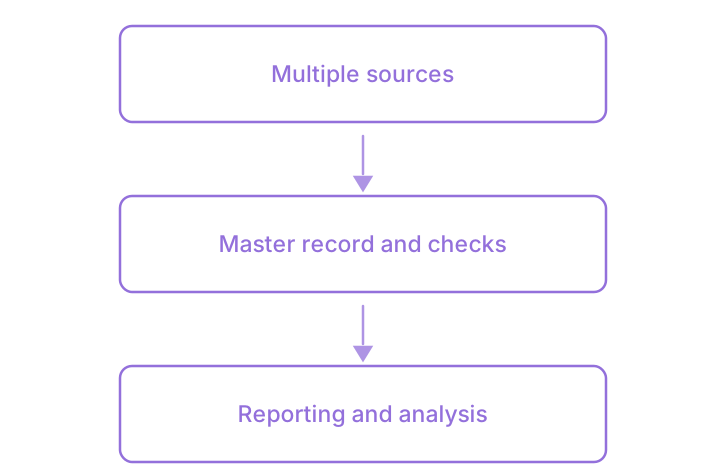
Several sources, one master record to arbitrate between them, then analysis: Batch Traceability & Genealogy and Core HR & Unified Repository stem from this same chain.
- HL7 / FHIR ProtocolsWriting of native connectors respecting the complex semantics of medical messages.
- Certified HDS HostingCloud infrastructures meeting the highest health data security requirements.
- Master Patient Index (MPI)Deduplication algorithms and absolute patient identity matching (INS, the French national health identifier).
- High Frequency RoutingProcessing tens of thousands of HL7 messages per hour without any loss.
- On-the-fly AnonymisationFunctions enabling the obfuscation of personal data for research purposes (eCRF).
- Error MonitoringSupervisory interface immediately signalling a message routing anomaly.
Smooth and frictionless integration
We do not replace your existing systems: we enable them to communicate. The platform connects to your current applications via their native interfaces, even when they date back to 2008. Deployment begins with one or two critical data flows (typically: identities and laboratory results), to validate the approach under real-world conditions before expanding.
IT teams retain control over routing rules and can adjust mappings without calling us. No massive migration, no three-week training for clinical staff: data simply arrives where it was missing.
Mapping of existing workflows
Inventory of existing systems, active interfaces and breakpoints identified by the teams. Identification of the 3-4 priority flows.
Implementation of the MPI Foundation
Deployment of the Master Patient Index and reconciliation of identities between your source systems. Consistency testing on anonymised real data.
Activation of initial flows
Connection of priority flows in parallel mode, validation with business teams, then progressive switchover to the new architecture.
Extension and autonomy
Connection of remaining systems, training of your IT team on administration tools, transfer of technical documentation.
Measurable results for your organisation
- Patient history access time reduced from 12 minutes to less than 30 seconds on average
- Elimination of duplicate data entry for 85% of administrative data
- Detection of patient identity errors before they reach the medical record
- Compliance with HAS traceability requirements without manual extraction
- 60% reduction in IT department time dedicated to interface maintenance
- Capability to connect a new application in days rather than months
Clarifying your decision-making
Our legacy systems still use HL7 v2.3, is this compatible?
HL7 v2.3 is compatible, and it is in fact the most common case: most French establishments run HL7 v2.x systems, sometimes with local variants. Clarendis handles translation to FHIR for modern applications and documents any discrepancies found, to ease future maintenance.
What is the risk of disruption for clinicians during deployment?
Disruption risk is close to zero: flows run through the platform in parallel with existing exchanges during a validation phase. Switchover happens only once data match on both sides. Clinicians simply notice that information arrives faster.