
Broker Extranets
An insurance broker who waits 48 hours to obtain a quote loses the deal. It’s as simple as that. In intermediated distribution, the battle is fought on responsiveness and the fluidity of exchanges between risk carriers and distribution networks. On the company or MGA side, the daily reality is less glorious: brokers ringing the commercial team to find out where their commission stands, authorisations managed in an Excel file that one prays never becomes corrupted, quotes sent by email that nobody can locate three months later during a dispute.
Commercial teams spend their days providing level 1 support instead of developing the network. Administrators re-enter data that has already been entered elsewhere. And meanwhile, brokers are comparing: whoever makes their life easier secures the business. The quality of your B2B tools has become a selection criterion as important as your pricing terms.
This solution belongs to the Partner & Network Extranets family.

Challenges holding back your performance
Many risk carriers have attempted to resolve this using makeshift solutions. A SharePoint for documents, a repurposed CRM to track brokers, Excel macros to calculate commissions. Each tool does its job reasonably well, but nothing communicates. The broker must juggle between three interfaces, remember several passwords, and still telephone for special cases.Some have invested in portals developed ten years ago, technically outdated, which no one dares touch for fear of breaking everything. Others have entrusted this to generalist providers who do not understand the specifics of intermediation: delegation management, multi-level commissioning, authorisations by product and by territory.Result: underutilised tools and brokers who prefer to pick up their telephone.
Our Technical Approach
Our approach stems from a fundamental observation: a broker extranet is not a website with a login. It is an extension of your management system to the external environment, with all the security and consistency constraints that this entails. We build an intermediation layer that exposes your pricing engines, your product repositories and your management rules via secure APIs.
The portal becomes an interface, not a parallel database. For authorisations, we model your reality: brokers as natural or legal persons, mandates by product, temporary delegations, territories. The rights engine adapts to your organisation, not the reverse. The commission module integrates your business rules: rates by product, by introducer, by production tier: and generates detailed statements that the broker can consult without telephoning you.
The whole system is built on a decoupled architecture: should you change your management system tomorrow, the portal adapts without complete reconstruction.
Permission Management
Strict segregation of portfolios between different brokerage houses.
B2B Quotation Editing
Advanced pricing tools with the ability to apply commercial discounts.
Commission Tracking
Transparent dashboards on production and earned remuneration.
Technical Architecture
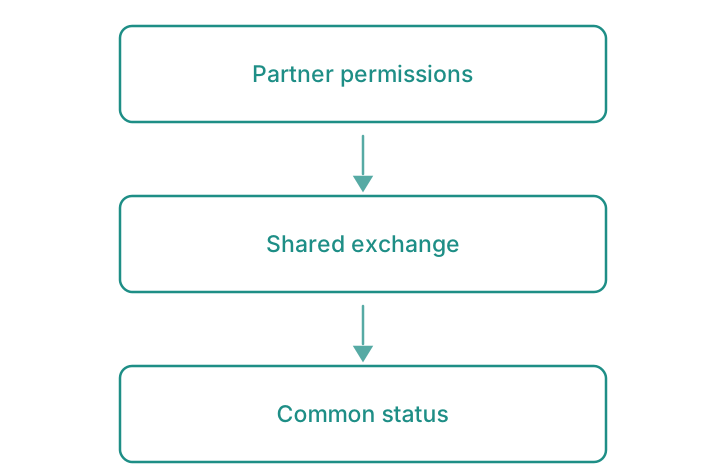
Grant each partner their permissions, exchange the flows, share one common status: that is what Partner Portals & Project Tracking and Dealer & Network Portal do.
- Permission ManagementStrict segregation of portfolios between different brokerage houses.
- B2B Quotation EditingAdvanced pricing tools with the ability to apply commercial discounts.
- Commission TrackingTransparent dashboards on production and earned remuneration.
Smooth and frictionless integration
We are not asking you to replace your management system or freeze your business activity for six months. The portal connects to your existing tools via API or through files if necessary. We typically begin with a restricted scope: one product, one region, one broker segment: to validate actual operation before expanding. Your IT teams retain control: complete technical documentation, accessible source code, knowledge transfer included.
Mapping of processes
Analysis of your current processes with brokers: quotations, underwriting, commissions, claims. Identification of friction points and source data.
Design and prototyping
Functional prototype tested with a panel of actual brokers. Validation of critical pathways prior to any development.
Development and integration
Construction of the portal with connection to your systems. Iterative deliveries every 3 weeks with continuous acceptance testing.
Deployment and transfer
Production deployment on a pilot scope, training of internal teams, technical documentation. Progressive expansion based on field feedback.
Measurable results for your organisation
- Average broker quote issuance time reduced from 15 minutes to less than 3 minutes
- 80% of commission tracking requests processed via self-service without human intervention
- 60% reduction in inbound calls to the commercial service regarding management enquiries
- Time required to authorise a new broker reduced from 5 days to 24 hours
- Portal adoption rate exceeding 85% within 6 months following deployment
- No re-entry required between broker underwriting and injection into the management system
Clarifying your decision-making
Our pricing engines are legacy and do not have APIs. Is this a blocking issue?
A legacy rating engine is not a blocking issue: Clarendis can encapsulate existing engines, including those running in batch mode or through files. It is not ideal in the long term, but it allows you to start without waiting for a full overhaul, and the interfaces are designed to migrate cleanly when you are ready.
How to ensure that brokers will actually use the portal?
Adoption comes from speed: the portal has to be faster than the telephone. Two or three pilot brokers are involved from the design stage to identify friction points. If obtaining a quotation takes more clicks than sending an email, something has been missed. Adoption is measured and adjusted after launch.