
Observatories & Open Data
Local authorities and public administrations are overwhelmed by transparency obligations. The Digital Republic Act, European directives on open data, accumulating FOIA requests: ever more datasets must be published, ever more rapidly. Except that GIS and IT teams have other urgent priorities. Data is scattered across departments in heterogeneous formats: proprietary GIS files, ageing Access exports, Excel spreadsheets manually maintained by staff who will soon retire.
And when it comes to publishing, the IT department applies the brakes: risks of personal data leaks, servers already saturated, no budget for a dedicated platform.
Result: observatories frozen since 2019, open data portals fed once a year during activity reports, citizens and researchers demanding up-to-date data. Meanwhile, neighbouring public sector organisations publish their data on data.gouv.fr and appear as models of transparency.
This solution belongs to the Data, Master Records & Reporting family.

Challenges holding back your performance
Most local authorities resort to makeshift solutions. Manual CSV export from the GIS, manual anonymisation in Excel: a member of staff deleting columns whilst hoping nothing has been overlooked. Publication on a basic web server or sending via email to those requesting it. No traceability, no guarantee of GDPR compliance.Generic open data platforms such as CKAN or OpenDataSoft require administrative skills that small teams do not possess. As for the established service providers in the public sector, they offer monolithic portals charged annually, which are rigid and quickly become empty shells due to lack of automated data feeds. Cartographic data remains trapped in PDFs or static images, rendering it unusable for those wishing to repurpose it.
Our Technical Approach
Our approach stems from a straightforward observation: the data already exists, it is simply poorly exposed. We begin by mapping the actual sources: business databases, GIS, shared files: and we establish automated extraction flows which respect the update rhythms of each service. Anonymisation is not a manual filter but a configurable algorithmic process: geographical aggregation to IRIS mesh level for sensitive data, removal of direct identifiers, parametrisable k-anonymity according to the nature of the datasets.
Dissemination operates through documented REST APIs which enable both human consultation via lightweight cartographic interfaces and machine integration by re-users. Cartographic visualisations rely upon open standards: WMS, WFS, GeoJSON: not upon proprietary formats which create lock-in. Each published dataset is versioned, with an accessible history.
Documented dissemination services
Cartographic visualisation of data
Algorithmic anonymisation
Technical Architecture
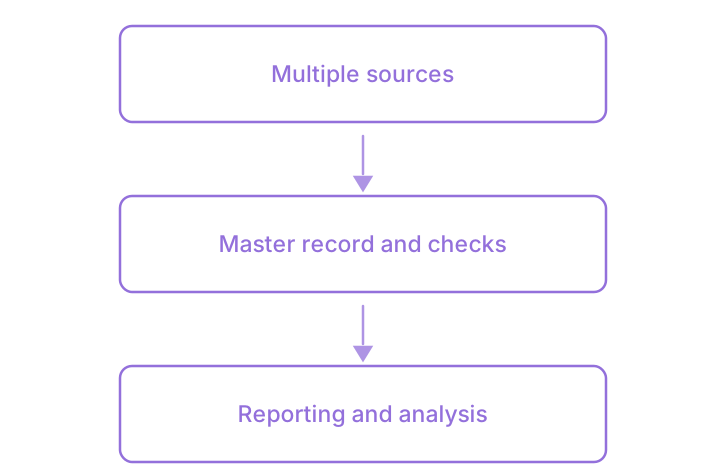
Several sources, one master record to arbitrate between them, then analysis: Core HR & Unified Repository and Batch Traceability & Genealogy stem from this same chain.
- Documented dissemination services
- Cartographic visualisation of data
- Algorithmic anonymisation
Smooth and frictionless integration
We do not replace your GIS or existing infrastructure. The connectors adapt to databases already in place: PostGIS, your Spatial database, Shape files or GeoPackage. The dissemination portal can integrate with your existing institutional website or operate independently. The feeds also supply data.gouv.fr automatically if you so wish.
No forced migration, no three-week training course: staff continue to work with their usual tools, publication becomes transparent.
Inventory of sources and obligations
Mapping of existing data, identification of datasets to be published as a priority according to your legal obligations and recurrent requests.
Configuration of flows and anonymisation rules
Implementation of connectors to your databases, definition of anonymisation processes with your DPO, testing on real data.
Deployment of the portal and APIs
Installation of the consultation interface, cartographic visualisations and documented dissemination services.
Autonomy and scaling up
Training of reference contacts for adding new datasets, documentation of procedures, gradual transfer of day-to-day management.
Measurable results for your organisation
- Delay for publication of a new data set reduced from several weeks to less than 48 hours
- 100% of published data undergoes an auditable anonymisation process
- 80% reduction in Freedom of Information requests through proactive disclosure
- Verifiable compliance with legal open data obligations
- Data reuse rates increased by a factor of 3 to 5 depending on the territories
- Zero personal data breach incidents on published games
Clarifying your decision-making
How do you ensure that no personal data is leaked in publications?
Each data stream passes through anonymisation rules defined with your data protection officer. The techniques applied are established ones — deletion, aggregation, k-anonymity — and an audit report accompanies every publication. If sensitive data is detected, publication is blocked automatically.
Our staff do not have the time to manage an additional tool. Who maintains the portal?
The portal is fed automatically from your existing sources: your staff carry on working in their business tools. Flows are configured once, then run on their own. Human intervention is limited to validating new datasets before their first publication.