
POS Commerce
In-store, the checkout remains the primary friction point. Queues during peak hours, sales assistants juggling between three screens to check stock, customers waiting whilst staff ’check in the stockroom’ when the information exists somewhere in the system. The problem isn’t the hardware: your EPOS terminals work, your tills do too. The problem is that each checkout point operates in isolation.
The city centre shop cannot see the retail park’s stock. The shop floor assistant cannot complete a sale without directing customers to the central till. Online purchase returns create lengthy manual procedures. And when the network goes down—because it always fails at the worst possible moment—everything grinds to a halt.
Meanwhile, your customers are comparing this with their most recent experience at a pure-play retailer: one-click ordering, two-minute collection. The gap is widening, and this isn’t a question of digital budget, it’s a question of the plumbing between your systems.
This solution belongs to the E-commerce & Booking family.
Challenges holding back your performance
Most retailers have layered on solutions: ageing till software, manual exports to the ERP, an Excel file for inter-store transfers, another process to reconcile web sales. Each new requirement has generated its own workaround. Generalist integrators propose complete overhauls with 18-month timescales that never materialise: too expensive, too risky, too lengthy.Till software vendors push their closed ecosystems which don’t communicate with your existing IT infrastructure.Result: store teams develop their own methods, customer data is fragmented across five databases, and nobody has a reliable view of actual stock levels. Head office operates blind, stores make do.
Our Technical Approach
Our approach stems from a simple observation: the point of sale must function even when everything else fails. We therefore build a two-speed architecture. Locally, each terminal has autonomous intelligence: it can process transactions, check store stock, apply promotions even without connection to head office. When the network returns, synchronisation is automatic and manages conflicts.
Centrally, we unify the customer view: web and store purchase history, loyalty programme, outstanding credits. The sales assistant on the shop floor accesses the same information as the central till, from a tablet or mobile terminal. Cross-channel returns management becomes a standard operation, not an exception that requires a manager. We interface your stock in real time so that the ’available in store’ displayed online corresponds to the reality on the shop floor.
Offline Mode
Utilisation of IndexedDB to ensure continuous payment processing without network connectivity.
Unified Client View
Upload of web purchase history and loyalty balance directly at the till.
Physical POS Terminal Interface
Direct connection to payment terminals (Nexo, Concert) to avoid duplicate entry.
Returns Management
Simple process to scan and receive back into stock an item purchased online.
Mobile Till
Tablet application enabling sales staff to process payments anywhere within the shop.
Synchronisation Stock
Real-time inventory decrementation to prevent unexpected stock-outs.
Technical Architecture
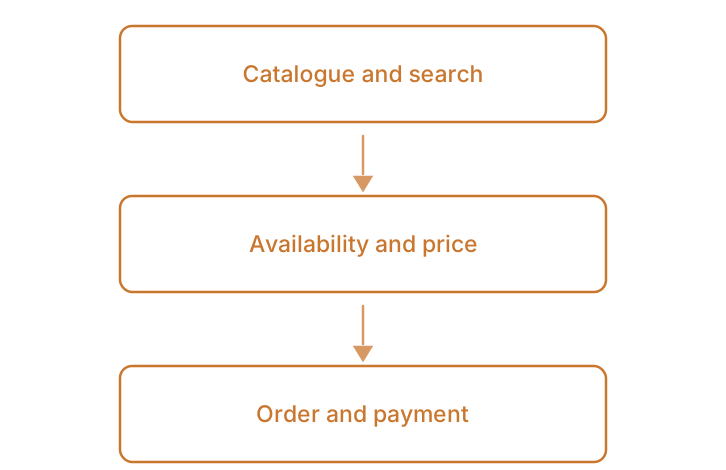
Search, check availability and price, order: these three steps also structure Online Auction Platform and Direct Booking Engines.
- Offline ModeUtilisation of IndexedDB to ensure continuous payment processing without network connectivity.
- Unified Client ViewUpload of web purchase history and loyalty balance directly at the till.
- Physical POS Terminal InterfaceDirect connection to payment terminals (Nexo, Concert) to avoid duplicate entry.
- Returns ManagementSimple process to scan and receive back into stock an item purchased online.
- Mobile TillTablet application enabling sales staff to process payments anywhere within the shop.
- Synchronisation StockReal-time inventory decrementation to prevent unexpected stock-outs.
Smooth and frictionless integration
We do not replace your till estate or your ERP system. We create the missing connectivity layer between your current terminals and your central system. Integration is carried out shop by shop, beginning with a pilot across one or two points of sale. Your teams continue working with their usual tools during the transition.
Existing card terminal connections are retained, accounting procedures are respected. We adapt to your retail chain’s pace: no service interruption, no mass training all at once.
Mapping of existing estate
Audit of your terminals, till software, flows to the ERP system and friction points identified by field teams. Deliverable within 2 weeks.
Pilot across 1-2 shops
Deployment of the synchronisation layer across a limited scope. Testing of offline mode, cross-channel returns and unified customer view under real-world conditions.
Adjustments and training
Correction of edge cases identified in pilot. Training of shop floor teams and head office support. Documentation of new procedures.
Progressive rollout
Store-by-store rollout according to your commercial calendar. Centralised monitoring and responsive support during scale-up.
Measurable results for your organisation
- Average checkout time reduced by 40% through the elimination of re-keying
- Zero lost sales during network outages — offline mode takes over automatically
- Sales conversion rates up 15 to 25% with mobile access to network stock
- Cross-channel returns processed in under 2 minutes versus 8 to 12 minutes with manual processes
- Automated daily accounting reconciliation — end of unexplained till discrepancies
- Unified stock visibility with less than 2% variance between system and field reality
Clarifying your decision-making
Our tills are 6 years old and are running Windows 7 — can you still provide service?
Clarendis works with the till equipment already in place, including older estates. Our software layer installs on existing systems and communicates through standard protocols. We have integrated heterogeneous estates spanning three generations of hardware. Replacement remains your decision, not a prerequisite.
How do you manage NF525 compliance and fiscal obligations?
Your certified till software remains the fiscal recording system, and Clarendis does not interfere with it. We position ourselves as an overlay, for customer experience and data synchronisation. Your compliance certifications remain valid and your audit procedures unchanged.