
Traceability & Quality Control
A batch of defective electronic components identified at an automotive client. 72 hours to trace back through the supply chain, identify all potentially affected products, notify the relevant clients. Your quality team searches through three different ERP systems, Excel files on a shared server, paper registers archived in a warehouse. The pressure mounts.
Calls from management come one after another. In the tech industry: semiconductors, electronic equipment, precision components: traceability is not a regulatory luxury. It is a matter of commercial survival. A poorly managed recall can cost millions in contractual penalties, not to mention client relationships.
Your operators are already capturing control data. Your systems record batch numbers.
But this information exists in silos, in incompatible formats, with gaps in the chain. When one needs to reconstruct the complete history of a product: raw materials, subcontractors, manufacturing parameters, test results: the puzzle becomes a nightmare. And ISO auditors or automotive clients do not exercise patience.
This solution belongs to the Data, Master Records & Reporting family.

Challenges holding back your performance
Excel remains the tool of choice for traceability. It records incoming batches, control results, and dispatches. It works: until the day when data needs to be cross-referenced. The links between a raw material batch, the work orders that consumed it and the finished products dispatched exist only in the heads of two or three people.The ERP records stock movements, not a genealogy. Market MES systems offer traceability modules, but their deployment takes 18 months and requires reviewing all your processes. Quality tools generate certificates, with no connection to production.Result: when an audit or crisis occurs, you manually reconstruct what the system should have known from the start.
Our Technical Approach
Our approach stems from a simple observation: the data already exists, it is simply dispersed and unconnected.
We construct a relational database which becomes the single reference repository for product genealogy, fed by your existing systems. Each batch: raw material, semi-finished, finished product: possesses a unique identity and bidirectional links with its parents and descendants. The ascending tree enables instant traceability to root causes: which supplier, which material batch, which machine parameters.
The descending tree identifies the impact: which customers, which quantities, which dispatch dates. Quality controls are digitised at the workstation, with automatic blocking of non-conforming batches: it is impossible to dispatch a blocked product. Certificates of analysis are generated within seconds, using actual production data.
And in the event of a crisis, a dedicated search interface enables complete mapping of a batch to be obtained in under two minutes.
Ascending Genealogical Tree
Immediately trace all components and suppliers of a defective batch.
Descendant Genealogical Tree
Identify all customers who have received a product manufactured with a suspect component.
Digitalisation of Controls
Tablet forms for strict input of dimensions, temperatures and tolerances.
Quality Lock
Computer block preventing the dispatch of a batch that has not received Quality approval.
Certificates of Analysis (CoA)
Automated generation of compliance documentation attached to the delivery note.
Rapid Search (Crisis Mode)
Ultra-high-performance search engine to isolate the impact of a crisis within seconds.
Technical Architecture
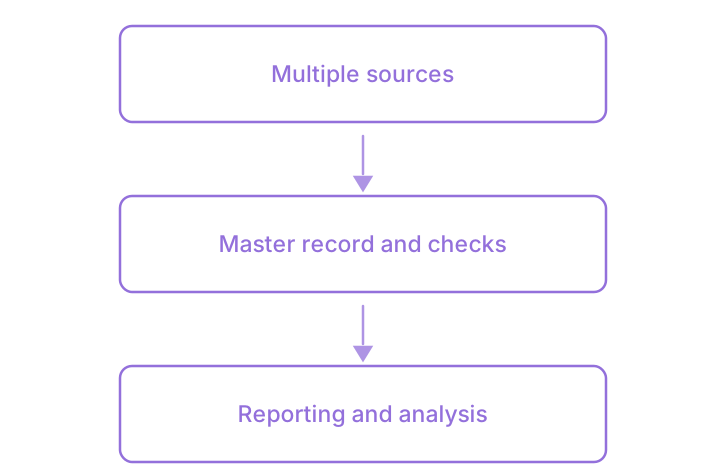
Several sources, one master record to arbitrate between them, then analysis: Batch Traceability & Genealogy and Core HR & Unified Repository stem from this same chain.
- Ascending Genealogical TreeImmediately trace all components and suppliers of a defective batch.
- Descendant Genealogical TreeIdentify all customers who have received a product manufactured with a suspect component.
- Digitalisation of ControlsTablet forms for strict input of dimensions, temperatures and tolerances.
- Quality LockComputer block preventing the dispatch of a batch that has not received Quality approval.
- Certificates of Analysis (CoA)Automated generation of compliance documentation attached to the delivery note.
- Rapid Search (Crisis Mode)Ultra-high-performance search engine to isolate the impact of a crisis within seconds.
Smooth and frictionless integration
There is no question of replacing your ERP or disrupting your workflows. The traceability database connects to your existing systems: ERP, supervisory systems, control files: via standard interfaces or automated imports. Operators continue with their usual data entry, with occasional enhancements. Deployment is carried out workshop by workshop, beginning with the most critical lines.
Your application assets remain in place, with genealogy grafting onto them as an additional layer of intelligence.
Mapping of existing flows and data
Analysis of your current sources (ERP, files, paper), identification of gaps in the traceability chain, definition of the priority scope.
Modelling and implementation of the database
Construction of the relational data model tailored to your products, creation of genealogical links, connection to source systems.
Field deployment and digitalisation of controls
Installation of input interfaces at critical stations, configuration of quality interlocks, training of operators and supervisors.
Activation of crisis functions and reporting
Implementation of rapid search functionality, automatic certificate generation, quality dashboards for daily operational management.
Measurable results for your organisation
- Recall search time reduced from several days to under 15 minutes
- Automatic generation of analysis certificates: 2 minutes versus an average of 45 minutes
- Zero shipment of blocked batches through integrated quality lock
- 60% reduction in recall perimeter through fine batch traceability
- Client and ISO audits prepared within hours rather than days
- Identification of the origin of recurring defects for targeted corrective action
Clarifying your decision-making
Our historical data is incomplete and poorly structured. Can we still get started?
A traceability project can start with incomplete historical data: Clarendis works from what exists and structures it properly from a reference date. History can be partially recovered, but the priority is a reliable foundation for the future. Within a few months, data depth covers most requirements.
How can we ensure that operators will actually input the information at the workstation?
Data entry has to be simpler than working around it: streamlined interfaces, barcode scanning, intelligent default values. Adoption comes above all from perceived usefulness, once teams see the data helps them retrieve information, justify a decision or avoid a problem.