
Bank Reconciliation Systems
Each month, your accounting teams spend several days reconciling thousands of lines. Bank statements on one side, invoices and entries on the other. Between bulk transfers that aggregate 47 invoices into a single line, SEPA direct debits with truncated references, partial payments, credit notes, value date discrepancies: reconciliation becomes an exercise in deduction worthy of an investigation.
And when you work with six different banks, two of which still send MT940 files via SFTP on Tuesdays at 6 a.m., the exercise becomes more complex. Your analysts know the rules by heart: they know that one particular client always pays three days late, that a certain supplier groups their invoices fortnightly. This knowledge is in their heads, not in your systems.
Result: stressful month-end closes, unexplained variances that linger, auditors asking questions, and critical dependence on two or three people who ’know how it works’.
This solution belongs to the Data, Master Records & Reporting family.

Challenges holding back your performance
Excel remains the tool of choice. Nested VLOOKUPs, eight-year-old macros that no one dares touch, files that crash beyond 50,000 lines. Market treasury tools perform reconciliation, but only for simple cases: one payment, one invoice, same amount. As soon as your flows become complex: batch payments, compensations, multiple currencies, intercompany transactions: they fall short.You end up with an automatic reconciliation rate of 40%, with the remainder done manually. Generalist providers offer banking connectors, but without understanding your chart of accounts, your business rules, your exceptions. You spend six months on configuration for a mediocre result.
Our Technical Approach
Our approach stems from a fundamental observation: the reconciliation rules that work are those your teams already apply intuitively. We begin by observing and formalising these implicit rules. The inference engine we deploy learns from your historical data: it identifies payment patterns by customer, recurring groupings, and tolerated variances.
This is not black box machine learning: every reconciliation decision is traceable and explicable to your auditors. Multi-bank connectivity is native: CAMT formats, MT940, parsed PDF statements, banking APIs where they exist. Variances are automatically qualified (timing, amount, missing reference) and routed to the appropriate contact with the necessary context.
Your teams no longer perform manual matching: they validate proposals and handle genuine disputed cases. The complete audit trail satisfies statutory auditors’ requirements without additional documentation.
Multi-Bank Connectivity
Secure and automated retrieval of flows via standardised market protocols.
Inference Engines
Intelligent algorithms capable of identifying matches despite imprecise descriptions.
Bank Reconciliation SystemsnnVariance Management
Automated processing of discounts, part payments or deducted bank charges.
Assisted Validation
Ergonomic interface suggesting the most probable matches for ambiguous cases.
Audit Trails
Absolute historisation of each reconciliation to facilitate the work of your auditors.
Technical Architecture
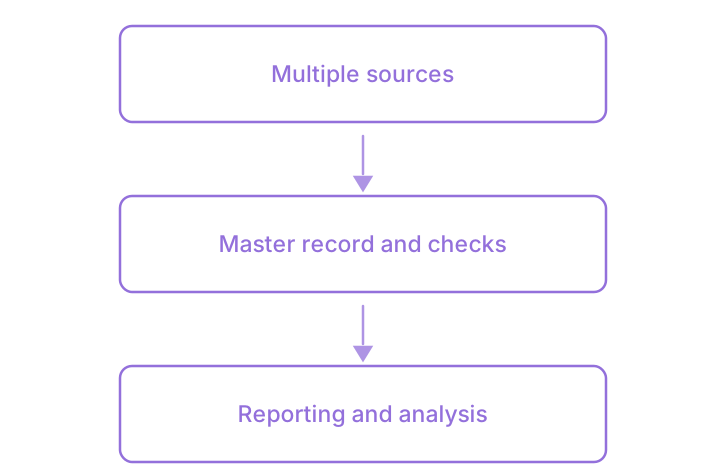
Several sources, one master record to arbitrate between them, then analysis: Observatories & Open Data and Batch Traceability & Genealogy stem from this same chain.
- Multi-Bank ConnectivitySecure and automated retrieval of flows via standardised market protocols.
- Inference EnginesIntelligent algorithms capable of identifying matches despite imprecise descriptions.
- Bank Reconciliation SystemsnnVariance ManagementAutomated processing of discounts, part payments or deducted bank charges.
- Assisted ValidationErgonomic interface suggesting the most probable matches for ambiguous cases.
- Audit TrailsAbsolute historisation of each reconciliation to facilitate the work of your auditors.
Smooth and frictionless integration
We connect to your ERP, whatever it may be — SAP, Odoo, Cegid… — as well as to your database, your accounting software and your business applications: without migration. Banking flows are retrieved in parallel with your current processes during a dual-operation phase. Your teams continue their usual work whilst the system learns. No big bang: we switch over progressively, bank by bank, scope by scope.
The reference data remains master in your source systems.
Mapping of flows
Analysis of your bank statements, received formats, current reconciliation rules (documented or otherwise), volumes and frequent discrepancy cases.
Connection and learning
Implementation of banking connectors, import of 12-month historical data, formalisation of business rules with your accounting teams.
Pilot in parallel
The system operates on a limited scope in parallel with your current processes. Rule adjustment, measurement of actual reconciliation rate.
Deployment and autonomy
Progressive extension to other banks and entities. Training of your teams on exception management and the evolution of rules.

Measurable results for your organisation
- Reduction of monthly reconciliation time from 4 days to 4 hours for a volume of 8,000 entries
- Automatic matching rate increasing from 35-40% to 85-92% depending on source data quality
- Advanced accounting close by 2 to 3 working days
- Unresolved differences addressed within 48 hours rather than lingering until the subsequent period-end
- Complete audit trail reducing auditor response time by 60%
- Reduced reliance on historical subject matter experts with rules now formalised
Clarifying your decision-making
What is the realistic matching rate that we can expect on our flows?
The bank reconciliation rate depends on the quality of your incoming data and the complexity of your flows. On simple payments, one transfer for one invoice, the rates Clarendis observes exceed 95%. On complex flows with grouped payments and intercompany transactions, they sit between 80 and 88%. We assess your current situation before committing to a figure.
How long before achieving concrete results?
The first reconciliation scope, one bank and one type of flow, is operational within 6 to 8 weeks in our deployments. Benefits are visible from the first closure. Full deployment across all your banks and subsidiaries typically takes 4 to 6 months.